LED Grow Lights in Vertical Farms: Spectrum, Efficiency, and Fixture Design
Artificial lighting in a vertical farm is not supplementary — it is the entire light budget. Buildings block natural daylight from reaching interior growing tiers, and even perimeter tiers with window access receive light at angles and intensities that are insufficient for consistent crop production at most latitudes. LED fixtures now dominate commercial indoor farming because of their spectral flexibility, lower heat output relative to high-pressure sodium alternatives, and continued improvement in energy conversion efficiency.
What Plants Use from Light
Photosynthetically active radiation (PAR) refers to the wavelength range — 400 to 700 nanometres — that plants use to drive photosynthesis. Within this range, chlorophyll molecules absorb strongly in the red (roughly 630–680 nm) and blue (400–450 nm) bands. Green light (500–560 nm) is reflected more than absorbed, which is why leaves appear green to human observers.
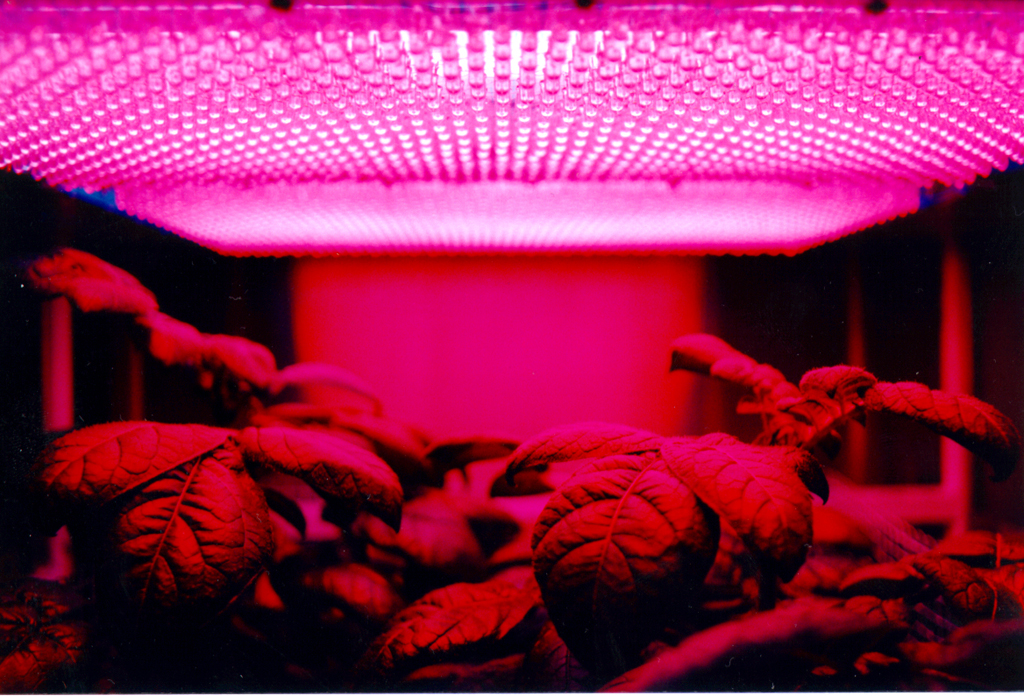
Early indoor grow lights used this absorption pattern to justify red-plus-blue LED combinations that produce a pink-purple appearance in growing rooms. More recent research has refined the picture: green and far-red wavelengths (700–750 nm) beyond the classical PAR range do contribute to photosynthesis, particularly in canopy layers where red and blue are partially absorbed by upper leaves. Full-spectrum fixtures that include green and far-red components have become the commercial standard.
Photosynthetic Photon Flux Density
Light intensity for plant growth is measured in micromoles of photons per square metre per second (µmol/m²/s), referred to as photosynthetic photon flux density (PPFD). Leafy greens perform well under PPFD values in the range of 150–250 µmol/m²/s, while fruiting crops like tomatoes require 400–600 µmol/m²/s or higher. The daily light integral (DLI) — total photons received per day — connects intensity to photoperiod: a lower PPFD over a longer light period can achieve the same DLI as a higher PPFD over fewer hours.
Fixture manufacturers report efficacy in micromoles of photons per joule (µmol/J). Higher values indicate more photosynthetically useful light output per unit of electrical input. Commercial LED bar fixtures for indoor farming have reached efficacy levels above 3 µmol/J in published product datasheets, though real-world performance depends on thermal management and fixture age.
Fixture Types in Multi-Tier Installations
Vertical farms use two dominant fixture form factors: panel arrays and linear LED bars. Panels are typically ceiling-mounted above a single growing tier. Linear bars — narrow, elongated fixtures — are attached to the underside of each growing rack, illuminating the tier directly below. The bar format is preferred in tight-tier spacing because it minimises the distance between light source and plant canopy, reducing the spread loss that occurs over longer distances.
Inter-tier spacing in multi-tier systems is a direct function of plant height plus the fixture depth and mounting clearance needed below the rack above. Leafy greens with canopy heights of 15–25 cm allow tier spacings of 35–45 cm, accommodating thin bar fixtures in a compact vertical footprint. Taller crops require wider spacing and reduce the number of tiers per unit height of building.
Heat management
LED fixtures convert a portion of electrical input to heat rather than light. Even at high efficacy, the heat component requires removal from the growing environment. Uncontrolled heat accumulation raises ambient temperature above the optimal range for leafy crops (typically 18–22°C for most lettuce varieties), increases water evaporation, and may reduce LED lifespan. Commercial bar fixtures incorporate aluminium heat sinks. Facilities with dense tier configurations often supplement natural convection with forced air circulation at each growing level.
Photoperiod Management
Unlike greenhouse production, vertical farm operators control the photoperiod — the daily light duration — independently of the season. Leafy greens are typically grown under 16–18 hours of light per 24-hour cycle. Some producers use a continuous light schedule (24 hours) for certain lettuce varieties, citing faster growth; others report tip burn in continuous-light conditions, a physiological disorder linked to calcium transport in fast-growing leaves.
The ability to shift the photoperiod off-peak allows operators to run lights during lower-tariff electricity hours. In Poland, where time-of-use electricity pricing is available to commercial consumers, scheduling the majority of light hours during night tariff windows reduces the energy cost per kilogram of crop without changing total photon delivery.
| Crop | Target PPFD (µmol/m²/s) | Typical Photoperiod | Notes |
|---|---|---|---|
| Butterhead lettuce | 150–220 | 16–18 h | Sensitive to tip burn at high DLI |
| Basil | 200–300 | 16–18 h | Far-red promotes internode elongation |
| Spinach | 150–250 | 14–16 h | Long days promote bolting — monitor DLI |
| Strawberry | 250–400 | 12–16 h depending on stage | Fruiting requires different spectrum balance |
Spectral Tuning
Some commercial LED systems allow operators to adjust the ratio of red to blue to far-red output during different growth stages. Seedlings and young transplants may be started under higher blue ratios, which promotes compact, sturdy growth. As plants mature, shifting toward higher red and far-red ratios can increase fresh weight and accelerate heading in lettuce.
The practical value of dynamic spectral tuning depends on the crops being grown and the sophistication of the monitoring setup. Smaller operations typically run fixed-spectrum fixtures at settings recommended by the fixture manufacturer for their primary crop, adjusting only photoperiod as needed.
Fixture Placement and Uniformity
Light distribution uniformity across the growing surface affects both crop consistency and resource efficiency. Fixtures positioned too far above the canopy lose intensity at the edges of the illuminated zone. PPFD mapping — measuring light intensity at multiple points across a growing tray using a quantum sensor — is a standard commissioning step in well-designed facilities. Target uniformity ratios (minimum PPFD divided by average PPFD) above 0.8 are considered acceptable for leafy crop production.
Reflective surface materials on rack side walls and the growing environment ceiling help redirect light that would otherwise be lost. White-painted surfaces or reflective mylar film are commonly used for this purpose in commercial installations.

Lighting Cost in Context
Electricity for lighting represents the largest single operating cost in most vertical farm configurations — estimates from published industry analyses typically place it at 25–40% of total operating expenditure, though this range varies significantly with crop type, tier count, and local electricity price. In the Polish electricity market, commercial tariffs have been subject to considerable fluctuation since 2021, making accurate long-term energy cost projection more difficult. Operators with higher installed lighting wattages have more exposure to these price movements.
The decision between a higher capital investment in more efficient fixtures and a lower-cost initial installation that carries higher ongoing electricity costs is a recurring calculation in facility planning. Payback calculations for premium LED efficiency depend directly on local electricity prices and hours of operation per year.